
WhatsApp Business for restaurants in Bahrain: what it misses
The problem is almost never receiving the message. It is the twenty minutes of typing, checking and asking that happen after the message arrives.
Home / Blog / How to stop riders calling customers for directions
Riders call when the address does not lead to the door. Make the building and unit required at checkout, add a map pin, and send all three to the riders' group with the order.
Anzul Aqeel · Founder & Director, Anunzio International FZC · 7 October 2026 · updated 16 October 2026
Here is how to stop riders calling customers for directions: make the building and the unit number required at checkout, and let the customer share a map pin. Then send all three to your riders' WhatsApp group with the order. GetMenu's checkout and its rider message do exactly this.
Riders call because the address they were given is not enough to find the door. In a district like Jumeirah Lake Towers in Dubai, dozens of towers stand in clusters, and a street address does not say which tower or which entrance. New housing estates in other cities have the same problem. A rider with a phone number and a short street name can only call the customer.
GoBolt, which studies parcel and last-mile delivery, finds that address errors cause 45% of failed deliveries, more than any other cause: incomplete addresses, unclear instructions and missing contact details. A restaurant rider meets the same problem with every order. Cities know it too: Dubai's Makani system gives building entrances a 10-digit code, because a building name or street address does not always lead a driver to the right door.
A restaurant has a second problem. When the customer does send a pin, it lands in the chat with the manager, who forwards it to the rider by hand. The fix is to collect the building, the unit and a pin once, at checkout, and give them to the rider in one message.
At a GetMenu checkout, a delivery order cannot be placed until the customer has picked a building and typed a unit number. The building comes from a list you keep, so a tower that riders know by one name is offered under that name. Each building carries its own delivery fee, and the list can be uploaded from a spreadsheet instead of typed in by hand.
The customer can also tap "Share my current location", which saves a GPS pin as a Google Maps link. They can write a note such as "second entrance, next to the pharmacy", and the note goes on your managers' ticket.
Free-text delivery instructions are often vague or missing. These fields work better because the building and unit are required and always have the same format. Uber Eats now lets the customer share a live location with the courier when the courier is 3 minutes away and the customer is within 100 metres of the drop-off point, TechCrunch reported. With your own ordering page, the pin comes at checkout, before the rider even leaves.
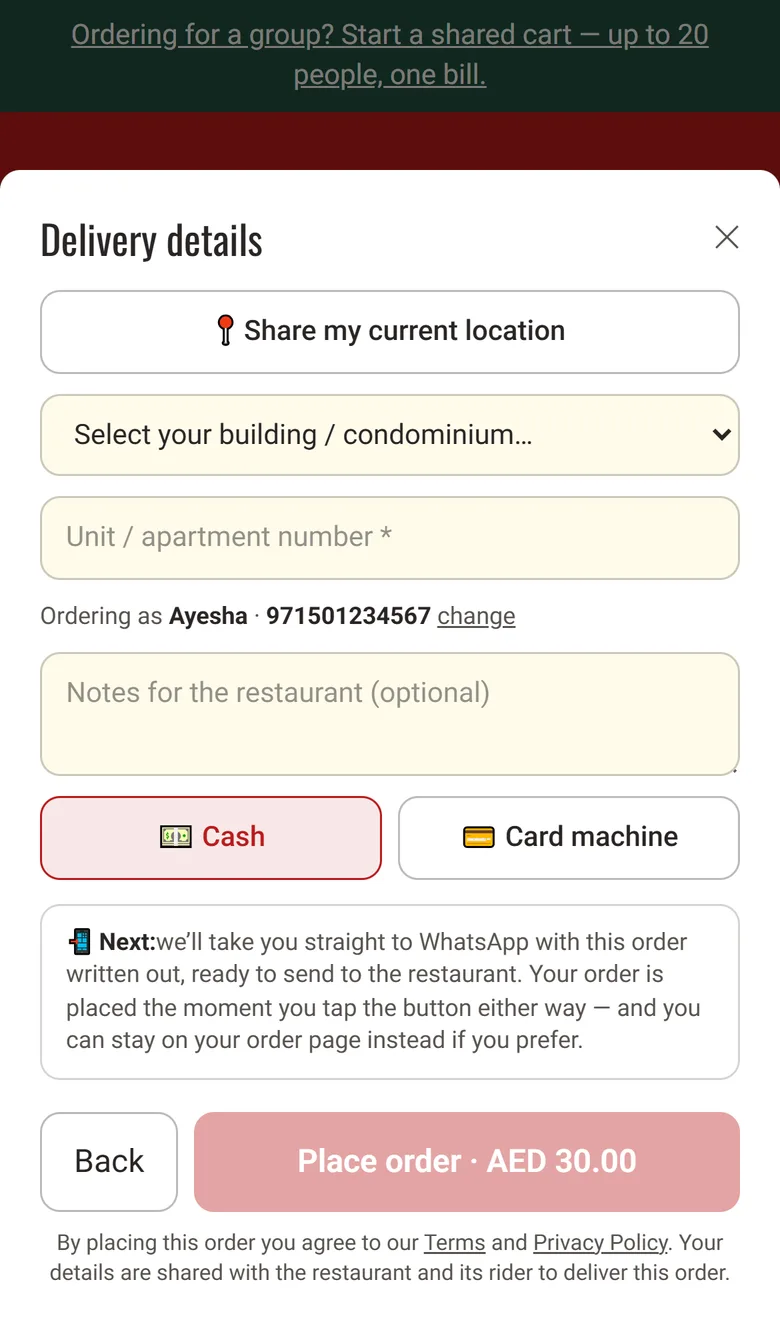
The moment the order is placed, your riders' WhatsApp group gets a message with the building and unit, the map pin as a link, the customer's phone, the dishes, and whether to collect cash or bring the card machine. The rider taps the pin, rides to the door, and taps one Delivered link when the food is handed over.
That link works once, for that order, for 12 hours, and it tells the customer the order has arrived. The managers' group gets its own ticket with the same pin and the customer's note. If a rider does need to ask, the manager has the answer in that message, and nobody has to call the customer. Each building on your list can also carry a private note for your staff, such as a gate code.
When you assign a rider on the orders board and that rider's team has its own WhatsApp group, the ticket is sent to that group too. The customer's "on its way" message names the rider and gives their phone number. The customer can also follow the order on its own status page, with no login needed. Phone orders typed in at the counter are sent to the riders the same way, and a rider can be sent from the POS on WhatsApp. See how delivery to buildings works for the full setup.
GetMenu does not track riders on a live map, plan routes or assign riders by itself. The rider is a person in a WhatsApp group with a good message. If you are comparing tools, our guide to food delivery software covers the wider choice.
The customer's confirmation comes from your own WhatsApp number the moment the order is placed. Plans take no commission on your orders, and the trial runs 15 days with no card.
Anzul Aqeel, the founder of GetMenu, ran a cafe of his own, Cafe Anunzio, before he built the ordering system. "Riders phone because the address was never an address. Give them the building, the unit and a pin in one message, and the phone stays in their pocket."
Parcel couriers use postcodes, sat-nav and codes such as Dubai's Makani number for a building entrance. A restaurant rider usually has only what the order carries, so the order has to carry enough. With GetMenu that means the building from your own list, the unit number and the customer's map pin, all in the riders' group message.
Because the address they were given does not get them to the door: the building has no name on the map, the street number is unused, or the pin is missing. They call to confirm a landmark or ask which entrance to use. When the building, the unit and a pin arrive with the order, the reasons to call disappear.
Give them once, at checkout, in the ordering page's own fields. Pick the building from the restaurant's list, type the unit number, tap "Share my current location" for a pin, and add a short note about the entrance. The building, unit and pin go to the riders, and the note goes to the managers' ticket.
On a GetMenu ordering page the customer taps "Share my current location" at checkout, and the phone's GPS pin is saved with the order as a Google Maps link. The rider opens that link with one tap. There is no app for the customer to install and nothing for the manager to forward by hand.
A Makani number is a 10-digit code that Dubai gives to building entrances, so a location can be found without a street name or number. It answers the same question as a map pin: where exactly is the door? A pin at checkout, together with the building and the unit number, does the same job in any city.
Call once, then send a short WhatsApp message to the number in the dispatch, so the customer has it in writing. Agree with your riders in advance how long to wait, and have them post in the riders' group before they leave, so the shop knows the food is coming back. The customer's phone is in the dispatch, so the rider never has to ask the shop for it.
The problem is almost never receiving the message. It is the twenty minutes of typing, checking and asking that happen after the message arrives.
Most kitchens here fail on running costs and on channels they do not control, not on the cooking. Both can be planned for before the first bag of rice is bought.